Support

Help center

Walkthroughs with screenshots for every role, plus answers to the questions we hear most. Choose your role to narrow everything down, or search for a specific task.

Tutorials

Everyone3 min read

Signing in to the right portal

One sign-in screen serves four roles. Administrators and teachers use an email and password, families use their student access codes, and students use their own code.

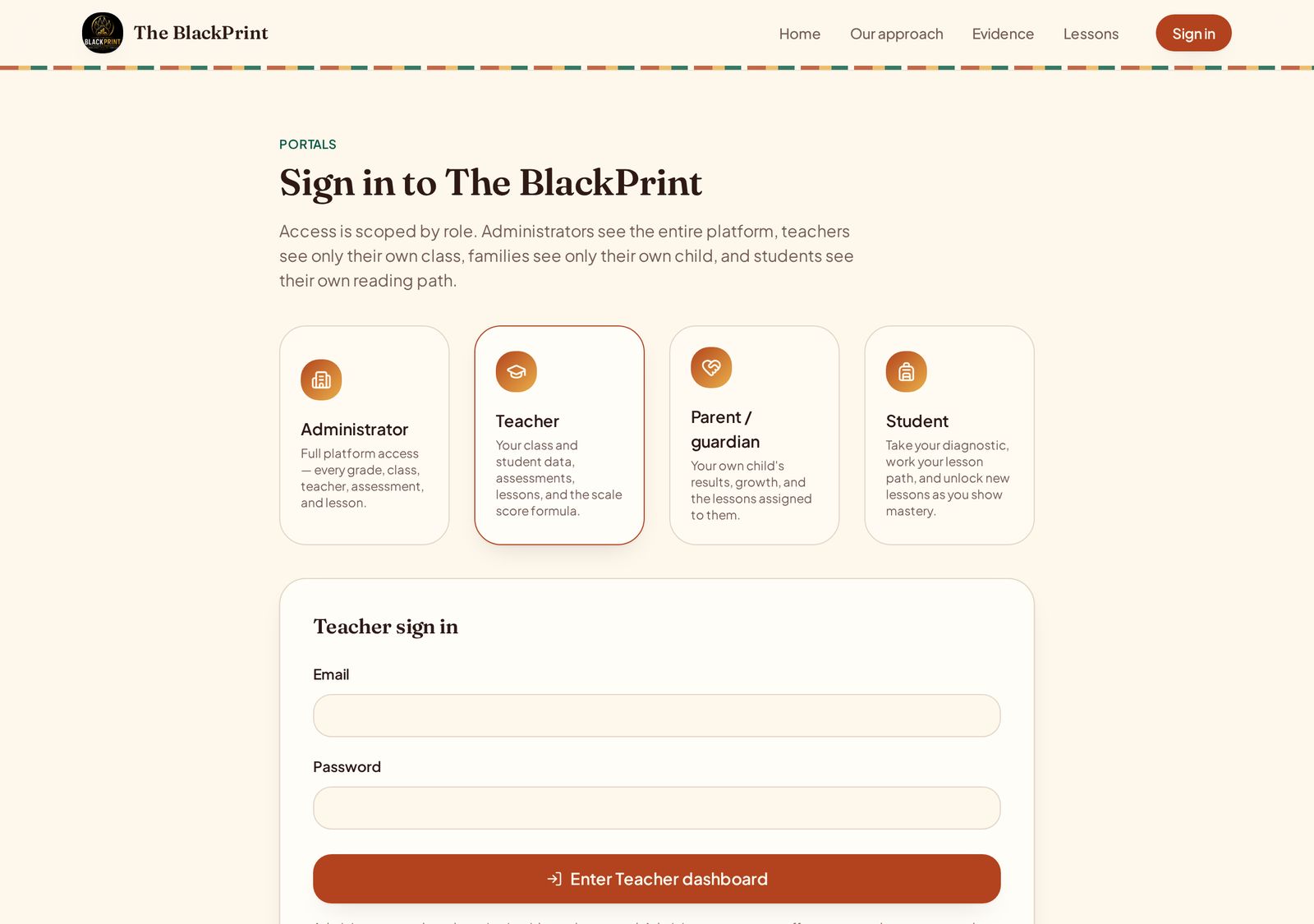
The BlackPrint sign-in screen with tabs for administrator, teacher, parent, and student
Sign-in screen — pick your role tab first, then enter your credentials or code.
  1. 1

    Open the sign-in screen

    Select Sign in from the top right of any page. You land on the portal screen with four role tabs: Administrator, Teacher, Parent & guardian, and Student.

  2. 2

    Choose your role tab

    The tab controls what the form asks for. Administrator and Teacher ask for the email address the invitation was sent to plus the password you created. Parent & guardian asks for one or more student access codes. Student asks for the single code printed on the student card.

  3. 3

    First time? Use the setup link

    Staff accounts never start with a password. Open the invitation email and choose the setup link, then create a password on the reset-password screen. If the email is missing, an administrator can resend it from Invite a user, Accounts, Send setup link.

  4. 4

    Forgot your password

    On the Administrator or Teacher tab, use Email me a password setup link. A fresh link arrives at your school email address and replaces the old password once you finish.

Good to know

  • Codes are not case sensitive; spaces and dashes are cleaned up automatically.
  • Signing out clears the session on that device only — shared classroom devices should always be signed out.
Everyone4 min read

How the three diagnostic windows work

Every reader takes the adaptive diagnostic three times a year. Each window has a job, and later windows unlock only after enough of the pathway is mastered.

  1. 1

    Baseline

    The first window is open from day one. It sets the scale score, the placement level in each of the six domains, and builds the individual learning pathway.

  2. 2

    Progress check

    Unlocks once the reader has mastered 50% of the assigned pathway. It confirms whether the gaps that were named at baseline are actually closing.

  3. 3

    Mastery check

    Unlocks at 75% pathway mastery. This is the end-of-year measure used for growth reporting to families and for placement next year.

  4. 4

    Reading the results

    Scores are criterion-referenced to the Missouri Learning Standards for English Language Arts, K-5. A placement level describes distance from grade-level expectation — it is never a label for the child.

Administrators6 min read

Setting up the school: teachers, admins, and classes

Administrators invite staff, generate class codes, and watch schoolwide and grade-level results. The live school starts empty until you add people.

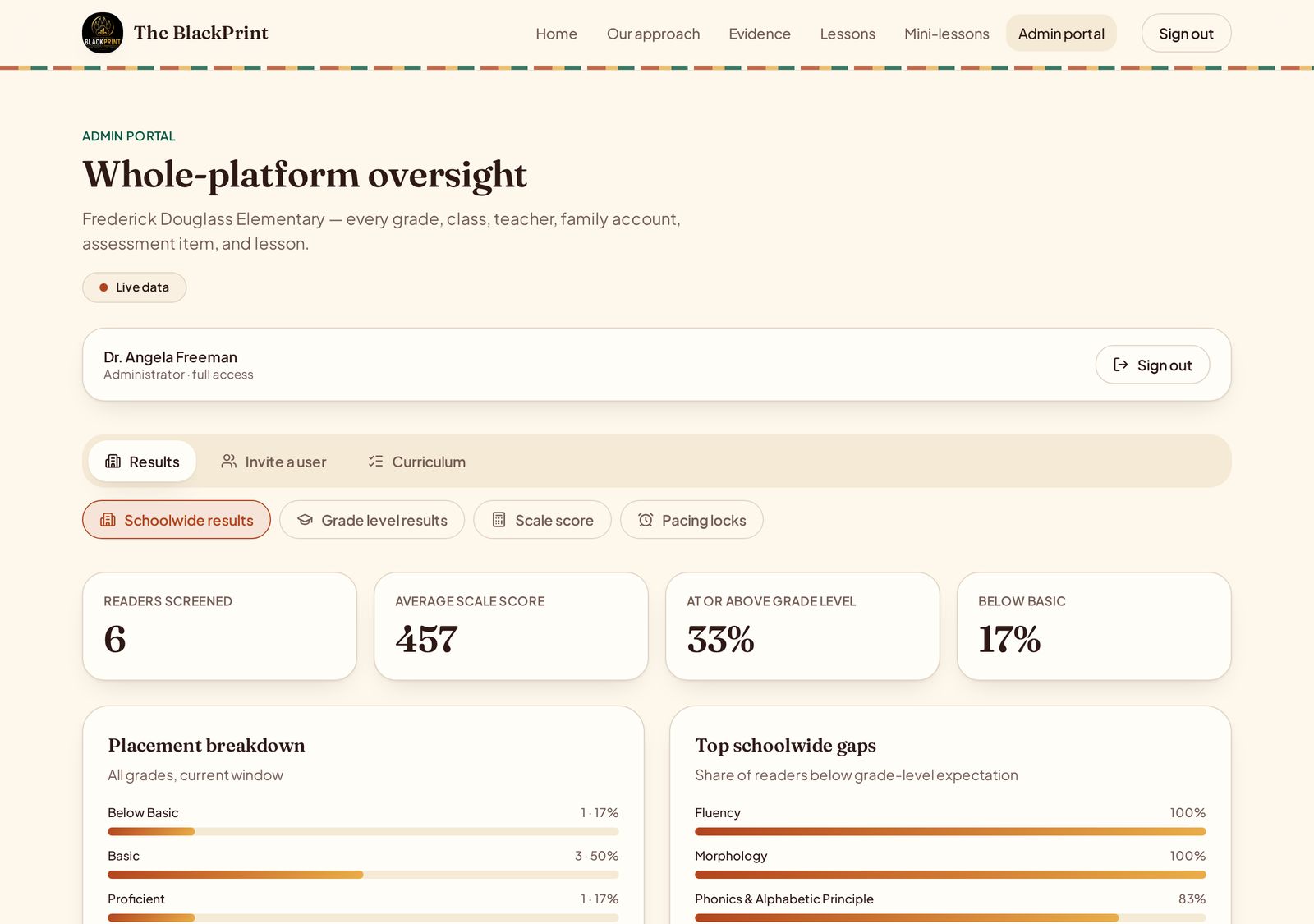
Admin portal showing Results, Invite a user, and Curriculum sections
Admin portal — sample view. Names shown are internal training data.
  1. 1

    Open the Invite a user section

    The admin portal has three sections: Results, Invite a user, and Curriculum. Invite a user holds Classes and Accounts.

  2. 2

    Add a teacher

    Enter the teacher's name, school email, and grade level. A class code such as READ-4821 is generated automatically and an account setup email goes out. You never type a password for them.

  3. 3

    Add another administrator

    Use Add an administrator to grant full platform access. They receive the same email invitation and create their own password.

  4. 4

    Manage existing accounts

    Under Accounts you can resend a setup link, send a password reset, or remove an account when staff leave.

  5. 5

    Review results

    The Results section shows schoolwide results, grade-level results, and the scale score anchor points so leadership can compare grades without opening each classroom.

Good to know

  • Students added by teachers appear automatically in the admin portal — you do not re-enter them.
  • Curriculum holds assessments and the lesson library if you need to preview what readers will see.
Administrators4 min read

Using View as and switching between live and demo

View as opens the platform exactly as another real user sees it. Demo mode is separate internal training data reserved for the platform owner.

  1. 1

    Pick a person to view as

    In the admin portal, choose a teacher, family, or student from the View as list. A banner stays at the top of every screen while you are viewing as someone else.

  2. 2

    Return to your own account

    Select Return to my account in that banner. Nothing you open while viewing as another user changes their data.

  3. 3

    Demo mode for training

    The platform owner also sees a Demo accounts tab. Demo accounts hold the sample roster used for training and cannot be signed into from the public sign-in screen. A Live data / Demo mode indicator always tells you which environment you are in.

Good to know

  • View as lists real users only, so an empty list means nobody has been added yet.
Teachers5 min read

Adding students and sharing family codes

Teachers build their own roster. Each new student generates a family access code and a student sign-in code.

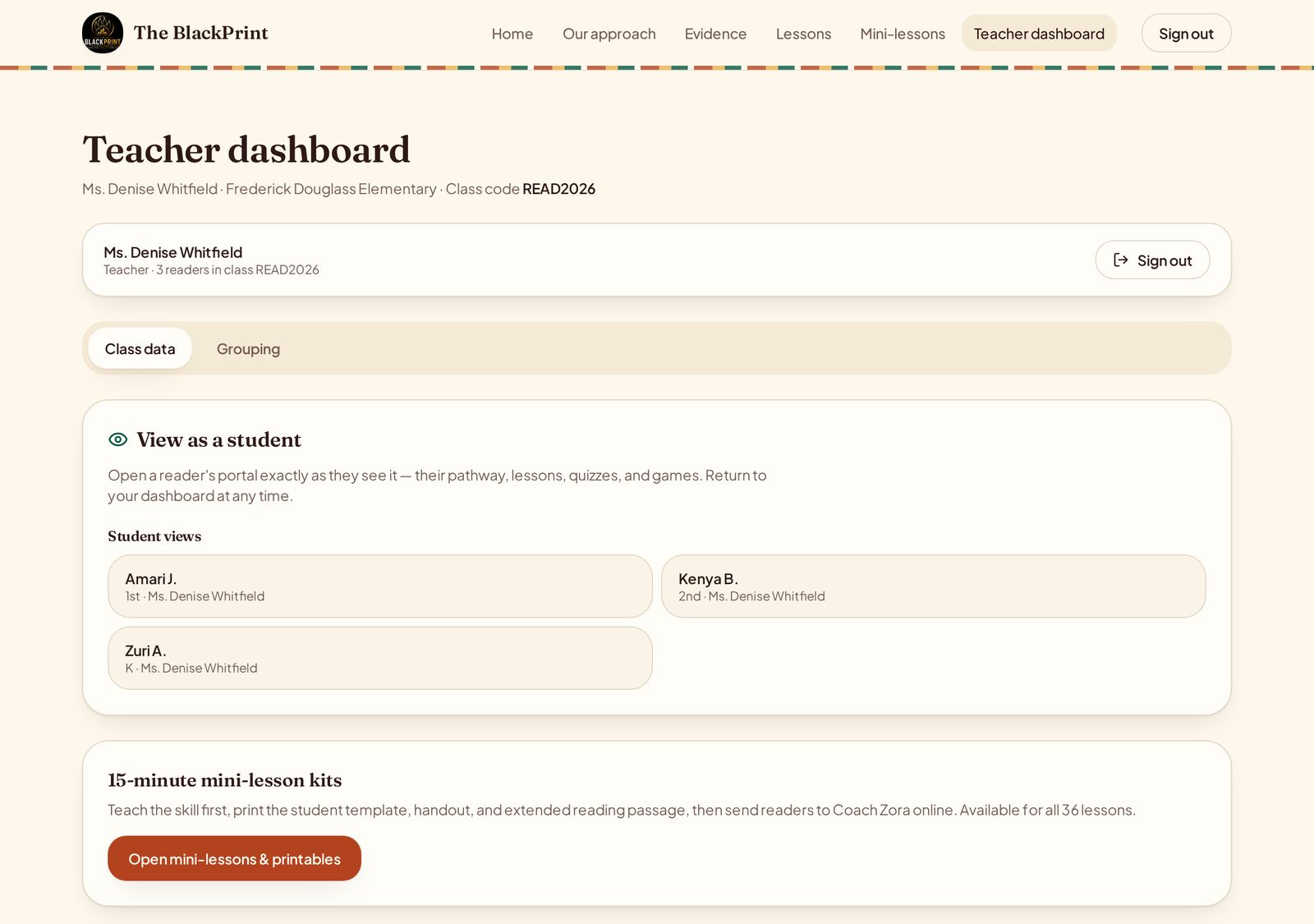
Teacher dashboard with class data and grouping tabs
Teacher dashboard — sample view. Names shown are internal training data.
  1. 1

    Open your dashboard

    Teacher dashboard shows your class code and only the grades assigned to you.

  2. 2

    Add a student

    Enter the reader's name and grade level. The platform generates a family access code and a student code, and the reader is added to your class and to the admin portal at the same time.

  3. 3

    Send the code home

    Give the family access code to the parent or guardian. They enter it on the Parent & guardian tab, and can add more codes if they have several children.

  4. 4

    Give students their code

    Students sign in with their own code on the Student tab. No email address is required for a child account.

Teachers5 min read

Turning diagnostic data into small groups

The Grouping tab sorts your readers by skill level inside every reading domain and proposes small groups with matching mini-lessons.

  1. 1

    Switch to Grouping

    On the teacher dashboard, use the Class data / Grouping switch. Grouping is generated from the most recent diagnostic — nothing to sort by hand.

  2. 2

    Read the urgency board

    Each of the six domains shows how many readers sit in Intensive, Strategic, On level, and Enrichment. Start with the domain carrying the most Intensive readers.

  3. 3

    Open a group card

    Group cards list four to six readers, their domain scores, and the recommended mini-lesson. Print the card and take it to the table.

  4. 4

    Teach, then release to the platform

    Deliver the 15-minute mini-lesson from Mini-lessons, then send readers to the matching online lesson so practice follows instruction the same day.

Good to know

  • Groups refresh after each diagnostic window, so re-check them at the progress check.
  • Mini-lessons include scripts, printables, and extended reading passages and stay teacher-only.
Teachers3 min read

Pacing locks: when a reader is rushing

The platform watches response pacing. When answers come faster than real reading allows, the work locks and waits for you.

  1. 1

    Spot the lock

    Locked assessments and lessons appear in the Pacing locks panel on your dashboard with the reader's name and what was locked.

  2. 2

    Conference first

    The lock exists to buy time for a short conversation about slowing down and using the strategy that was taught.

  3. 3

    Unlock

    Only a teacher or administrator can release a lock. Choose Unlock and the reader resumes from where they paused — saved work is never lost.

Families5 min read

Reading your child's report and pathway

Families see plain-language placement, growth over time, the learning pathway for the year, and at-home activities.

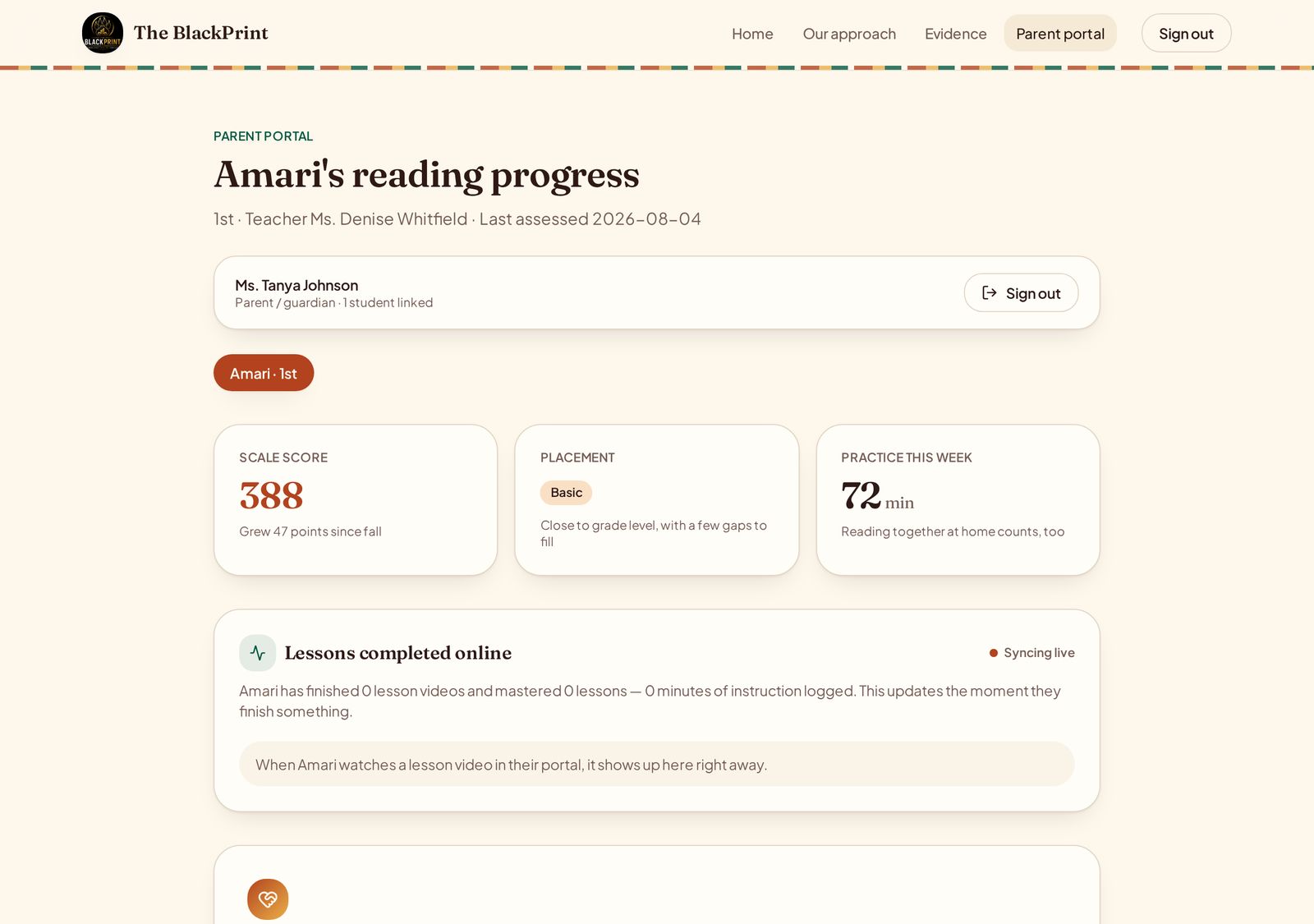
Parent portal showing a child's reading summary
Family portal — sample view. Names shown are internal training data.
  1. 1

    Enter your access code

    Sign in on the Parent & guardian tab with the code your child's teacher sent. Add a second or third code with Add another child.

  2. 2

    Read the placement summary

    Each domain is described in everyday language: what the skill is, where your child is now, and what growth looks like next.

  3. 3

    Follow the progress timeline

    The timeline shows how the scale score and each domain changed across the baseline, progress check, and mastery check.

  4. 4

    Print the pathway

    The individualized pathway to mastery is a map of the school year. Use the print button to keep a copy for conferences.

  5. 5

    Try the at-home activities

    Every report ends with short activities matched to the current gap — ten minutes a night is enough to matter.

Students5 min read

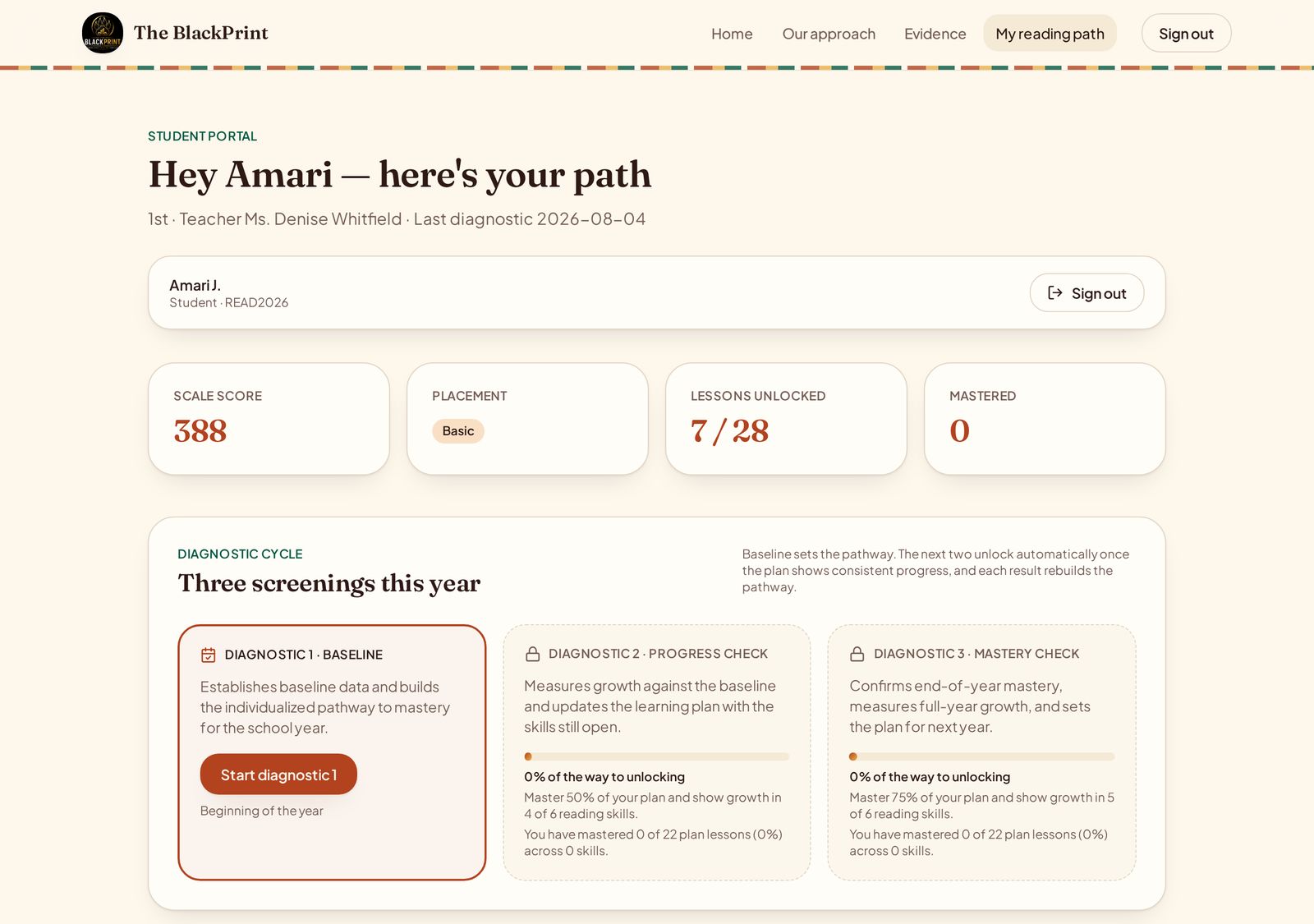
Working your reading path with Coach Zora

Students see only their own lessons, quizzes, and games. Each lesson is taught on screen, then checked with ten questions.

Student portal showing My Reading Path with lessons and games
Student portal — sample view. Names shown are internal training data.
  1. 1

    Sign in with your code

    Use the Student tab and type the code from your card. Your reading path opens right away.

  2. 2

    Take the diagnostic when it opens

    The assessment starts on its own — no settings to choose. A timer runs, and you may pause and come back later.

  3. 3

    Do the lesson

    Coach Zora explains the skill, models it, and practises with you. Watch and say the words out loud with her.

  4. 4

    Pass the quiz

    Answer the ten questions. Score 80% or higher to unlock the next lesson. A retake always gives you new questions.

  5. 5

    Unlock games and enrichment

    Master a domain and its game unlocks. Score proficient or advanced and enrichment lessons open too.

Good to know

  • Going too fast locks the work until your teacher talks with you — read every question.
Teachers3 min read

Finding lessons and printable materials

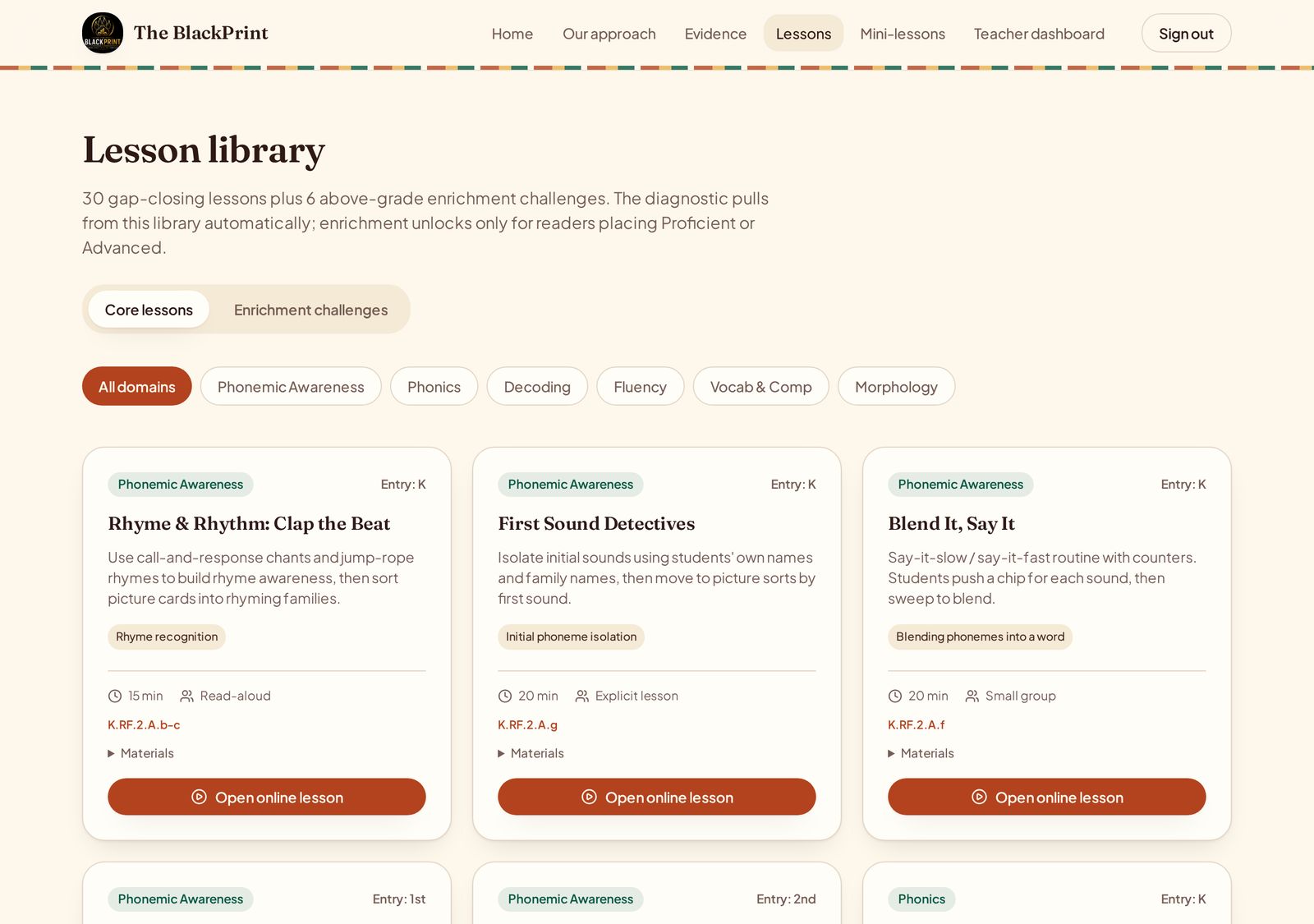
The lesson library covers all six domains. Mini-lessons hold the teacher scripts, student templates, and extended passages.

Lesson library grouped by reading domain
Lesson library — staff view.
  1. 1

    Browse by domain

    Lessons are grouped by phonological awareness, phonics, decoding, fluency, vocabulary and comprehension, and morphology.

  2. 2

    Open the matching mini-lesson

    Mini-lessons gives you the 15-minute teacher-led version of the same skill with everything you need to print.

  3. 3

    Print student-facing pages

    Student templates, handouts, and reading passages are all print-ready. Extended passages stay inside the teacher portal.

Frequently asked questions

I never received my setup email. What now?+

Check spam and any district quarantine first. An administrator can then open Invite a user, Accounts and choose Send setup link to send a fresh one. Links expire, so always use the newest email.

Everyone

Can I sign in with any password?+

No. Administrator and teacher accounts use real password sign-in. Passwords are created by the account holder from the setup link and can be reset from the sign-in screen.

Everyone

I lost my child's access code.+

Your child's teacher can see the code on their dashboard and resend it. Codes are tied to one student, so each child has their own.

Families

I have more than one child on the platform.+

Enter the first code, then choose Add another child and enter the next. All of your children appear in one family portal and you can switch between them.

Families

Why don't I see lessons in the family portal?+

Lessons are assigned and delivered by the teacher and completed by your child in the student portal. Families see the results, the pathway, and at-home activities instead of the staff lesson library.

Families

Why is the live platform empty?+

The live environment belongs to Hope Leadership Academy and starts with no teachers, students, or families. Data appears as soon as staff are invited and teachers add their readers.

Administrators

What are the demo accounts for?+

Demo accounts hold internal training data for practising with the platform. They are visible only to the platform owner, cannot be signed into publicly, and never mix with live school data.

Administrators

Why can I only see my own grade level?+

Teachers are scoped to the grades assigned to them, so the dashboard shows only their class and student data. Schoolwide and grade comparisons live in the admin portal.

Teachers

A student cannot start the progress check. Why?+

The progress check unlocks at 50% pathway mastery and the mastery check at 75%. Check the reader's pathway progress — completing assigned lessons at 80% or better is what moves the counter.

Teachers

How do I release a locked assessment or lesson?+

Open Pacing locks on your dashboard and choose Unlock. Only teachers and administrators can unlock, and the reader resumes exactly where they stopped.

Teachers

Do I get the same quiz if I retake it?+

No. Every retake draws a new set of ten questions on the same skill, so you have to use the strategy rather than remember answers.

Students

Can I stop in the middle and finish later?+

Yes. Use Pause. Your answers and your place are saved, and you continue from the same spot next time you sign in.

Students

How do I unlock the games?+

Each domain has its own game and it unlocks once you reach mastery in that domain, which means scoring 80% or higher on the lessons for that skill.

Students

What standards is the scoring based on?+

All placement levels and scale scores are criterion-referenced to the Missouri Learning Standards for English Language Arts, K-5 (SBOE, Spring 2016).

Everyone

Does The BlackPrint replace our core reading curriculum?+

No. It is a supplemental diagnostic and intervention layer. It names specific skill gaps and provides targeted lessons and small-group tools alongside daily core instruction.

Everyone

Can materials be printed?+

Yes. All student-facing materials, group cards, pathway maps, and family reports are print-ready from the browser print dialog.

Everyone

Still stuck?

Families should start with their child's teacher — they can resend access codes and release locked work. Teachers should contact a building administrator, who can reset staff accounts and class codes from the admin portal.